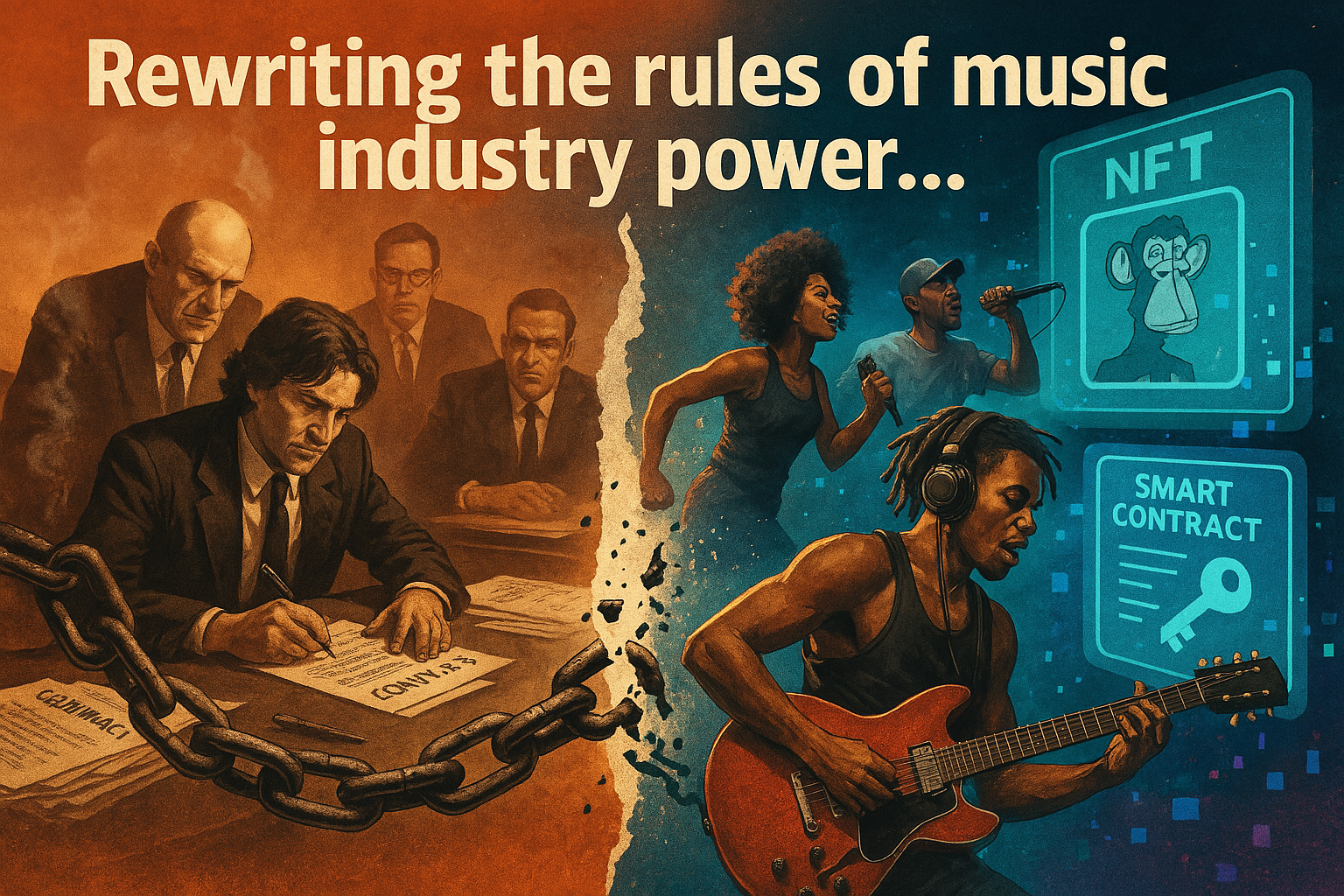
The Evolution of Record Deals - Artists Breaking Free from Traditional Contracts
Recording Contracts Explained
| Contract Element | Description |
|---|---|
| Purpose & Scope | Enables labels to exploit recordings via physical media, broadcasting, and digital formats (e.g. DualDisc, ringtones). |
| Exclusivity | Artist signs exclusively; clauses like “sideman” or pseudonyms may allow limited external work. |
| Territory | Major labels often demand worldwide rights; indie deals may allow regional splits. |
| Contract Term | Usually 12 months, extended annually; capped by long-stop clauses (typically 6–7 years). |
| Rights Granted | Labels get master rights for up to 50 years; can keep unreleased work; rarely return ownership. |
| Release Commitments | Artists should negotiate minimum marketing and guaranteed releases; may include buy-back rights. |
| Advances & Recoupment | Advance is royalty pre-payment; covers recording costs and potentially artist income; manager commissions must be clarified. |
| Royalties | Typical rate: 14–18% of dealer price (less deductions); packaging, returns, free goods, and foreign sales reduce payout. |
| Secondary Income | Artists should push for 50% share from syncs, licensing, compilations, etc. |
| Promos & Tours | Labels cover promo costs (non-recoupable); tour support often recouped, so negotiate limits. |
| Creative Control | Negotiate rights over videos, remixes, tracklist, artwork, and use of likeness; studio budget and producer selection should be artist-approved. |
| Accounting & Audits | Royalty statements should be twice-yearly; right to audit if discrepancies are found. |
| Termination Clauses | Include breach, label merger, liquidation, or failure to release; ensures artist recovers rights in key scenarios. |
| Re-recording Restrictions | Typically last 5 years post-contract; applies only to released songs. |
| Controlled Compositions | Songwriters often receive reduced mechanical royalties; U.S. contracts may cap payment per album. |
Music Publishing Contracts Explained
1. Contracting Parties
All contracts begin with identifying the parties involved, the individuals or entities entering into the agreement.
NileFlow Music, hereinafter called the Publisher, and Kalimani Beats, hereinafter called the Writer. Throughout the contract, it will refer to either as the Publisher or the Writer.
2. Date
The date when the contract is signed. This date serves as a fixed point of reference for all subsequent references within the contract.
This AGREEMENT made as of 1st December 2025.
3. Term
All contracts specify a term, which is the duration the parties are bound by the agreement. This should not be confused with how long the contract covers all the song copyrights. The term begins from the signing date. For instance, after naming the parties, the contract might state, "the term is for five years." It may also specify that the copyright retention period extends for five years after the end of the initial term.
"Thus, the term starts on the signing date, and the combined length of the copyright assignment or license is the term plus the retention period, 5 years + 5 years = 10 years. However, the writer can exit the contract after five years if the terms are met. The songs will remain with the publisher through the retention period. For illustration, If an artist signs a deal with Universal Music and the contract expires, they can enter into a new agreement with a different publisher for new material. However, the works created before will stay with the previous publisher (Universal Music) until the retention period ends.
The publisher takes a risk by signing the writer or artist. They pay advances through the contract. It takes time for the publisher to earn income worldwide. They need to activate covers and use the songs to make a profit and gain a financial return. After the retention period ends, the copyrights revert to the writer/artist. The writer/artist can then make deals on their back catalog and new work. However, this depends on the writer meeting the minimum commitment. In the past, writers signed long-term contracts for the "life of copyright." This meant the publisher kept the songs for the writer's lifetime and several years after their death. Also, the publisher’s secured song covers may extend the retention period for those copyrights. If the contract is not recouped during the initial term, it can be extended until full recoupment. This extension may have a maximum limit (Gammons, 2011).
4. Territory
The contract should specify the territory to which it is binding (Gammons, 2011).
"The contract will specify an assignment or a license of publishing rights for the UK market, European Union market, or global market. The territory can be a single country, a group of countries, or the entire world. ‘Territory’ shall mean the world and all parts of the universe. The universe is often included in most contracts because of satellite and other transmission systems outside Earth that may be used, or even a future moon base".
5. Royalties
Royalties show how income is shared between the writer (copyright owner) and the publisher. The contract details areas for negotiation, such as performance income, print, mechanicals, and synchronization. The phrase "and any other income" covers extra income streams and new uses that may come up. Royalties can change in favor of the writer or artist in certain defined situations in the contract.
For instance, a contract might set a 70/30 split on mechanical income, giving the writer 70% and the publisher 30%. However, for covers, the split may change to 60/40, favoring the publisher.
This setup lets smaller independent publishers reward their local sub-publishers for generating income. It also helps major publishers pay their offices for securing new income for writers not signed locally. This situation is common in these agreements (Gammons, 2011).
Royalties Explained
| Royalty Type | Typical Split | Notes |
|---|---|---|
| Performance Income | 50/50 to 80/20 | Writer may negotiate up to 80% in their favor |
| Mechanical Income | Same as Performance Income | Negotiable similar to performance income splits |
| Synchronization Income | 50/50 to 70/30 | Publishers may incur extra costs (agents, legal) |
| Sheet Music | Net receipts or % of retail | Usually outsourced; income calculated post-costs |
| Covers | 10–20% lower than contract rates | Subpublishers incentivized; writer share adjusted accordingly |
6. Advances
Advances paid under the contract are usually recoverable, not refundable. Refunds are possible if money was obtained through deception or fraud. There are several ways advances can be paid. Typically, there is a set amount on signing to validate the contract. Payments can also occur at key times, like contract anniversaries or through rollover advances.
A roll-over advance is an initial payment that, once recouped, leads to another payment within specific contract terms. Publishers often avoid these payments in the last 12 to 18 months to prevent risking unrecoverable amounts late in the term.
Negotiating and providing advances is complex. They can depend on factors like the number of songs delivered, percentage control over each song, chart hits, and pipeline income. These factors often relate to the contract’s term and control length. Therefore, it’s vital to work with an experienced lawyer and a solid accountant (Gammons, 2011).
7. Assignment
An assignment is the transfer of ownership of rights by an owner to someone else. A writer/artist can assign all or some rights. An assignor (writer/artist) is the owner of the rights. The owner (writer/artist) no longer owns rights when they are assigned. Typically, in an exclusive writer contract or a single-song assignment the contract states (Gammons, 2011).
“The Writer hereby assigns to the Publisher.”
8. Licensing
In licensing, the copyright owner, or songwriter, keeps the rights. They allow the publisher to do specific things with the copyright.
An administration contract is part of this license. The publisher handles registering, managing, and collecting royalties in a certain area for a set time.
As the name implies, an administration contract allows for the management of copyrights. Usually, this is a business-to-business agreement, meaning it occurs between publishers and territories (Gammons, 2011).
A writer who wants to control their catalogue might consider self-publishing. This often suits experienced writers with a developed catalogue but who lack time to register songs and track royalties. They might decide to hire a publisher instead.
In exchange for the publisher's services, the writer pays an administration fee. This fee usually ranges from 10 to 15% of the gross income the publisher receives during the agreement. Note that current economic pressures may limit deals where only 10% is charged.
Typically, no advances are paid, and there’s no creative involvement from the publisher. The publisher usually just collects income from the catalogue's activity. If a writer wants a more hands-on relationship, they can opt for a sub-publishing agreement that usually includes advances. Alternatively, they could sign an Exclusive Writer Agreement directly with a publisher (Gammons, 2011).
9. Accounting Period
In the music industry, the accounting period is typically every six months
30 June and 31 December, within 90 days.”
10. Audit
The writer and a qualified accounting representative can check the publisher's books. This ensures the accounts are correct. The contract should allow for an annual audit if the publisher gets proper notice. Audits can be expensive, so the writer will hire a professional accountant for this job. If the artist has a big hit, it is wise to audit when royalties are high. An audit may also be needed if their accountant or lawyer thinks their artist has not received enough payment for their music. Most audit clauses cover the reasonable costs of an audit if the writer finds under-accounting. The contract will specify how much under-accounting must occur before the audit costs are covered. This amount is usually a set figure or a percentage of the unpaid royalties (Gammons, 2011).
Any audit will occur during regular business hours at the Publisher's location for accounts and statements. An audit may only happen once for each statement. If the inspection finds a discrepancy of £2000 or 5%, whichever is higher, the Publisher will cover the Writer's reasonable inspection costs (not including travel, meals, or lodging). If a deficit over 10% of the total amount during a period is found, the Publisher will promptly pay the Writer. This payment includes all outstanding amounts and interest, plus the reasonable inspection costs. However, the inspection cost covered by the Publisher cannot exceed the total deficit amount.
11. Legal Jurisdiction
All contracts will be bound under the legal jurisdiction of a given country and therefore the courts of that country. This clarifies which country the writer will have to fight a legal battle in if they had to defend or take action on a contract in court.
Therefore, if the writer is based in Kenya, ensure that all contracts signed are under Kenyan law and the jurisdiction of a Kenyan court. If based in the United States or Europe, then contracts will come within the American or European legal system respectively.
References
Gammons, H. (2011). The Art of Music Publishing: An Entrepreneurial Guide to Publishing and Copyright for the Music, Film, and Media Industries. Focal Press.
Salmon, R. (2007). Recording contracts explained. https://thisninjanerd.com/ghettoPatreon/wp-content/uploads/2023/10/Recording-Contracts-Explained-1.pdf
Recommended Reading
Creative Counsel. (n.d.). Music industry contracts: The ultimate list and guidance. CreativeCounsel.io.. https://www.creativecounsel.io/music-industry-contracts/
U.S. Copyright Office. (n.d.). What musicians should know about copyright. https://www.copyright.gov/engage/musicians/
U.S. Copyright Office. (n.d.). Copyright registration of musical compositions and sound recordings (Circular 56A). https://www.copyright.gov/circs/circ56a.pdf