Hip-Hop as a platform for Cultural Resistance and Social Commentary
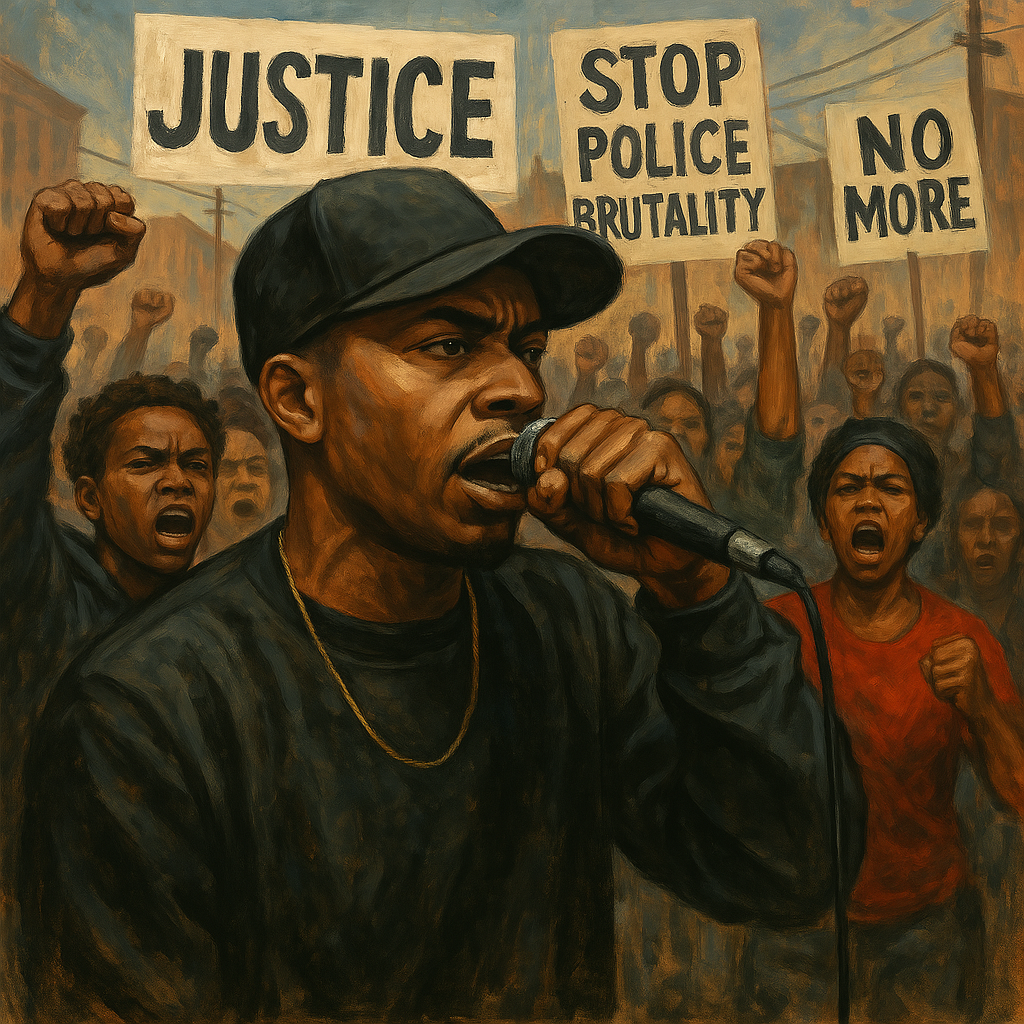
Hip-hop’s origins trace back to urban spaces where creativity thrived despite socio-economic deprivation. Hip-hop culture provided underprivileged groups or communities an authoritative platform for social interpretation, political action, and demonstration. From its beginning, hip-hop has provided artists with a platform for activism to challenge systemic injustices and advocate for change. Public Enemy, a revolutionary rap group in the 1980s, used their music to address racism, police brutality, and inequality. Their anthem ‘Fight the Power’ became a rallying cry for liberation and opposition. Hip-hop’s most powerful aspect is its capacity to magnify marginalized voices and shed light on important social issues (The American News Staff, 2025). “Art is political… artists demand their audiences think through the troubling history of slavery” (Sciullo, 2018, p. 86), reflecting the parallel between hip-hop music and visual art as instruments for historical reckoning.
Artists like Chuck D of Public Enemy and Kendrick Lamar have positioned hip-hop as a tool for political expression and resistance to perceived injustices. Chuck D of Public Enemy famously proclaimed that ‘rap is Black America’s CNN (Sciullo, 2018, p. 96). “We felt like we were speaking for a generation that didn’t have a voice,” emphasizing hip-hop’s role as a vehicle for truth and representation for Black communities. Likewise, Grandmaster Flash and the Furious Five’s The Message’s lyric, “Don’t push me ‘cause I’m close to the edge,” captures the daily tension in the inner cities and neighborhoods, critiquing the structural injustice using emotional realism. While Kendrick Lamar’s ‘Alright’ became a soundtrack to anti-police brutality protests. Public spaces were reclaimed as stages of protest, embedding music with purpose beyond entertainment (Richardson, 2023). “Wyclef sang ‘Who’ll be the next to fire forty-one shots by Diallo’s side?’” (Sciullo, 2018, p. 97), calling attention to police brutality and racial injustice. Likewise, “Talib Kweli released ‘Papers Please’ to challenge Arizona’s anti-immigration law” (Sciullo, 2018, p. 98), demonstrating how hip-hop critiques xenophobic legislation and defends minority rights. “Salt-N-Pepa rapped ‘You’re just as good as any man, believe that, word’” (Sciullo, 2018, p. 68), anchoring hip-hop feminism in direct confrontation with systemic inequities.
Another perfect example of hip-hop activism is Childish Gambino’s This is America. The lyrics of the song in and of themselves depict the Black American struggle with racism and the impact of gun violence, the sense of needing to conform to White societal values, and the apparent helplessness. In the cinematographic interpretation, Childish Gambino parodies the imagery of Black people in the American media throughout history. From the Jim Crow stance to background images of viral violent content to highlight all facets of the struggles of Black people in an anti-black America. This method of communication is important as it can quickly be popularized by mass culture and communicates a message without actively trying to do so. In a little over four minutes, Childish Gambino can lightly touch on a wide variety of issues in a manner that is pleasing (or captivating) to the public (Prange, 2020).
Other examples of hip-hop activism include Dapper Dan, who made knockoffs acceptable and repurposed corporate logos for his own ends (Sciullo, 2019, p. 90), amplifying hip-hop’s remix culture as both subversive and commercially viable. ‘Raise Up’ which featured only the Black people’s arms and heads, invoking ‘hands up, don’t shoot’” (Sciullo, 2019, p. 87). Hank Willis Thomas’s sculpture was tied directly to the Ferguson protests, a visual echo of hip-hop’s activism. Similarly, Wiley had depicted Judith as black, implicitly having committed violence against a white person, challenging tired tropes of Black subservience” (Sciullo, 2019, p. 86). Hip-hop art is used by artists as a radical opposition to racial hierarchies, which is consistent with hip-hop's cultural resistance.
Free Speech, Censorship, and Legal Persecution
Law enforcement and political entities have regularly accused hip-hop artists of inciting violence, fueling debates on censorship. The hip-hop genre faces disproportionate scrutiny, especially targeting Black and Latino artists. In authoritarian regimes, voicing dissent through rap lyrics may lead to imprisonment, highlighting hip-hop’s role as high-risk civic engagement. Since the early 1980s, the style and content of rap music have alarmed many listeners. Some songs have depicted explicit sexual or violent content, causing early moral panic that shaped censorship efforts. Many opponents have argued that some rap lyrics are beyond the threshold of acceptable speech and qualify as obscenity. This reframing of rap lyrics places the artists in legal jeopardy (EBSCO Information Services, 2022).
The opponents of rap music have described their campaign against record companies and artists as not directly censoring controversial music, but delegitimizing it. This is a strategic effort to pressure record labels into abandoning artists without invoking formal censorship laws. Despite courtroom victories for freedom of expression in rap, rappers and their music continued to be subject to restrictions and censorship, showing that legal wins do not always result in real artistic freedom. In 2008, the rapper Nas was forced to change the title of an album he intended to name after a racial slur; the album went untitled, demonstrating how self-censorship is driven by marketplace constraints (EBSCO Information Services, 2022).
According to the ruling of the 1973 Miller v. California U.S. Supreme Court case, obscene materials are not protected by the First Amendment. Material considered ‘obscene’ can be restricted if an average person applying local community standards finds that it appeals to prurient interests; if the work is patently offensive; and if it lacks ‘serious literary, artistic, political, or scientific value. Prurient indicates nefarious, debasing, or extreme fascination with sexual subjects. Justice William O. Douglas dissented, arguing that ‘ideas having even the slightest redeeming social importance’ should have full protection of the First Amendment. Equally, Burger claimed to be returning to the Roth test, abandoning as ‘unworkable’ the ‘utterly without redeeming social value’ test of Memoirs (EBSCO Information Services, 2023).
Several legal cases have shaped the intersection of rap music and First Amendment protections. In Elonis v. United States (2015), the Supreme Court examined whether rap lyrics posted online constituted a “true threat,” ultimately siding with Elonis and emphasizing the importance of intent in threat jurisprudence. Earlier, in Skyywalker Records v. Navarro (1990), Broward County Sheriff Nick Navarro prosecuted the 2 Live Crew album As Nasty As They Wanna Be for obscenity, prompting a federal district court to declare the album obscene under the Miller v. California (1973) test. This decision was reversed by the 11th U.S. Circuit Court of Appeals in Luke Records v. Navarro (1992), which found that the album had serious artistic value, invalidating the obscenity claim. Another pivotal case, Davidson v. Time Warner (1997), involved the family of a slain Texas trooper who sued Time Warner over Tupac Shakur’s album 2Pacalypse Now, alleging that its anti-police lyrics incited violence. The court rejected the argument, reaffirming that advocacy protected by the First Amendment does not constitute imminent lawless incitement (Hudson, 2023).
Progressively, prosecutors have indicted rap artists under several true threats laws centered solely on the content of their song lyrics. The alarming trend highlights use of expressive art as primary evidence for criminal prosecution. The evidence includes stanzas such as those describing the killing of police informants and police officers as the sole basis for witness intimidation and terroristic threat charges. Prosecutors are using lyrics alone without additional evidence to institute serious criminal indictments. They ignore the fact that rap music is often a form of political expression and resistance, particularly for marginalized communities. Rap music is vital for democratic speech, especially when those voices are otherwise excluded. Moreover, the prosecution of rap lyrics serves as a proxy for suppressing Black identity and dissent. Rap music censorship is related to racial profiling and institutional silencing. Courts should import the third prong of the Miller test, which analyzes whether the work, taken as a whole, lacks serious literary, artistic, political, or scientific value. This approach allows for a nuanced legal framework that respects artistic and cultural worth as part of the First Amendment protections (Vining, 2020).
Symbolism, Legacy, and Future Movements
Over 50 years, hip-hop’s endurance lies in its ability to evolve while retaining its protest roots. The genre nurtures movements like Black Lives Matter, standing as both historical archive and future strategy. Hip-hop summits now occur regularly around the world… affecting thousands of youths on nearly every continent” (Sciullo, 2019, p. 97), illustrating organized global activism inspired by hip-hop culture. Hip-hop teaches students of sociology about social movements, history, crime, law, and society” (Sciullo, 2019, p. 54). Education positions hip-hop as a pedagogical and activist tool. Hip-hop celebrates local spaces as symbolic centers for community resilience and activism with statements such as “The corner was our Rock of Gibraltar, our testimonial to freedom, peace, and love” (Sciullo, 2018, p. 55). Hip-hop’s endorsement of different drugs sounds threatening and advocating for unchecked consumption, yet some of the artists are describing their lived experiences” (Sciullo, 2018, p. 61). Hip-hop activism through vulnerability represents realities of marginalized communities rather than idealized behaviors. KRS-One raps, ‘Instead of broadcasting how we smoke them trees, we need more local emcees (Sciullo, 2018, p. 62). KRS One resists mainstream glorification of vice and promotes grassroots empowerment. Others like Fab 5 Freddy laid the groundwork for hip-hop art that was not confined to a certain medium, location, or even city” (Sciullo, 2018, p. 84) to demonstrate the underground ethos that still shapes the boundaries of hip-hop authenticity; Basquiat adored by white elites but never completely removed from the SAMO persona” (Sciullo, 2018, p. 85). His duality reflects tensions between mainstream fame and underground identity.
References
EBSCO Information Services. (2023). Miller v. California. EBSCO Research Starters. https://www.ebsco.com/research-starters/law/miller-v-california
EBSCO Information Services. (2022). Rap music and censorship. EBSCO Research Starters. https://www.ebsco.com/research-starters/music/rap-music-and-censorship
Hudson, D. L. Jr. (2023, August 11). Rap music and the First Amendment. The First Amendment Encyclopedia. Middle Tennessee State University. https://firstamendment.mtsu.edu/article/rap-music-and-the-first-amendment/
Prange, M. (2020, May 12). Hip hop and social movements. Studies of Black History at the University of San Diego. https://sites.sandiego.edu/blackhistoryatusd/2020/05/12/hip-hop-and-social-movements-maxwell-prange/
Richardson, J. (2023). Hip-Hop: The Powerful Tool for Social Change and Activism. https://medium.com/@johnisharichardson12/hip-hop-the-powerful-tool-for-social-change-and-activism-ff47626a0708
Sciullo, N. J. (2018). Communicating hip-hop: How hip-hop culture shapes popular culture. Bloomsbury Publishing USA.
The American News Staff. (2025, April 15). Exploring hip-hop’s cultural and social impact. The American News. https://theamericannews.com/exploring-hip-hops-cultural-and-social-impact/
Vining, A. (2020). Rap as a proxy for Blackness: How the prosecution of rap lyrics continues to unconstitutionally restrict free speech rights. University of Florida Journal of Law & Public Policy, 31(1), Article 16. https://scholarship.law.ufl.edu/jlpp/vol31/iss1/16