Hip-hop in Russia
Russian rap took root properly in the early 1990s, following the collapse of the Soviet Union. Some argue that the earliest rap in Russia was “Rap” (1984) by the rap group Chas Pik, an unofficial remix of The Sugarhill Gang’s 1979 “Rapper's Delight”. The 1990s brought in popular Russian rappers and rap bands like Bogdan Titomir, Liki MC, Bad Balance, and Mal’chishnik. Rap music was suited to the culture because of the country’s profound artistic traditions and abundant history in performance art. It got fully entrenched during Putin's reign, departing from its wholesale copying of American artists. (Miszczynski & Helbig, 2017).
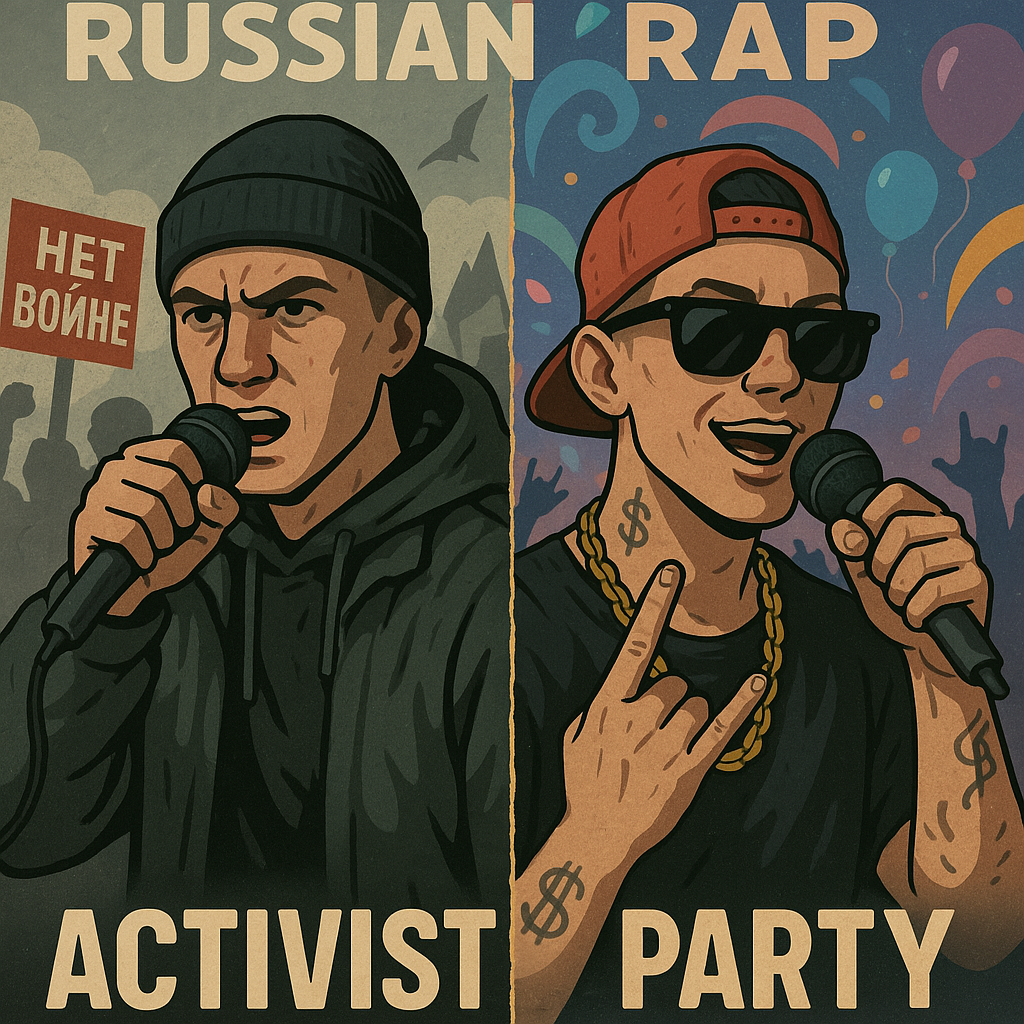
Contemporary Russian rap music is generally divided into two camps. The first group is the party rap camp, characterized by upbeat lyrics about love, partying, and socializing, while the second camp is the activist and political camp, characterized by stirring lyrics on current issues. Most performers and tracks fit into these two categories. However, the party rappers are more likely to succeed in Russian rap due to subject matter (Miszczynski & Helbig, 2017).
Conceivably, the most famous Russian social activist rapper is Ivan Alekseev, or Noize MC. Noize MC studied classical guitar during his early years. In his 20s, he was a performing hip-hop artist, becoming infamous as a rapper. He is universally considered the greatest Russian-speaking freestyle rapper. In 2008, he released his debut album, ‘The Greatest Hits, Vol. 1’. It was selected as album of the year by the popular Russian lifestyle magazine, Afisha. Noize admitted to the sarcasm of the album's name since he had completed more than 200 songs before its release (Miszczynski & Helbig, 2017).
Just like in the United States, Russian rappers are facing legal issues related to law enforcement and activism. However, Russian authorities have far more liberty concerning what actions they can take against an individual when in their custody. Noize MC pointed out that the authorities did not let him communicate with his lawyer, producer, or any other person. Noize MC expresses his dissent from the official interpretations of the Russian government. There has been a potent outpouring of nationalistic fervor during Putin's term in office. This nationalism is typically demonstrated in racist acts (Miszczynski & Helbig, 2017).
For example, in March 2011, in reply to the signing of footballer Roberto Carlos, the foremost nonwhite player to play for the Zenit team, a racist aficionado displayed a banana, which is a commonplace xenophobic meme aimed at nonwhite players in European football leagues. Noize MC’s riposte to this explicit racist act was “Pushkinskii Rap” (Pushkin Rap). Alexander Pushkin, largely regarded to be the greatest Russian writer of all time, had a great-grandfather of African descent. Pushkin himself had non-Russian physical characteristics and a somewhat darker complexion. Noize MC used this truth to question the xenophobic followers of Zenit. The music video starts in the stadium with the supporters chanting “Peter,” another name for Zenit. Noize MC employs Pushkin as the song’s speaker, questioning the objectives of the foolish xenophobic aficionados (Miszczynski & Helbig, 2017).
Another Russian rapper whose lyrics are even more provocative than Noize’s is Vasya Oblomov. Vasya Oblomov is the alias of Vasily Goncharov. He launched his music career in 1999 as the lead of Cheboza, a Britpop-influenced rock band from Rostov-on-Don. His earliest megahit was the rap song ‘Magadan’, released in 2010 and earned many honors. In this song, he uses mockery to address numerous existing issues in contemporary Russia. As an artist, performer, author, activist, and scholar, Oblomov frequently incurs the wrath of the Russian authorities, which can be dangerous in contemporary Russia. Although his technique is termed rap, he favors the label “songs of a conversational style.” He habitually blends these songs with stimulating and thoughtful musical soundtracks (Miszczynski & Helbig, 2017).
His songs mainly address various injustices in the Russian political system and the many quirks of Russian culture, such as widespread bribery in the police force in “Kto khochet stat’ militsionerom?” (Who Wants to Become a Police Officer?), the elitist concentration of power and corruption in the judiciary in “Zhal’” (Too Bad), the despair of the culturally underprivileged in “Magadan,” or the disputed polls of December 2011 in “Paganen’kii u nas narod” (Our Rotten Little Nation). His most confrontational songs are written by him and performed with two well-known political activists and TV personalities, Ksenia Sobchak and Leonid Parfenov: “Poka Medved” (So Long, Medvedev), “VVP” (referring to Vladimir Vladimirovich Putin), and “Rap Moleben” (Rap Prayer). The first is a public message to then-President Medvedev with a bluntly dismissive tone, criticizing Medvedev’s judgments regarding Putin’s return to power. The second criticizes Putin directly. The third, ‘Rap Prayer,’ addresses the chaos surrounding the Pussy Riot incident (Miszczynski & Helbig, 2017).
The most well-known pro-government Russian rapper is Timati (Timur Yunusov). He aligns with the hip-hop party camp, and his lyrics are seldom provocative. He has performed with American artists Snoop Dogg (at a high cost), Busta Rhymes, Timbaland, and P. Diddy. He has many loyal fans. Timati is also an entrepreneur, launching numerous projects in fashion (Black Star by TIMATI) and a Production Company (Star Factory 4). Timati’s main goal is to promote Russian artists internationally. His connection with the current Russian government benefits him. All opportunities are open to him, and he is free to pursue any venture he chooses. There is a large following for this type of hip-hop, and many emerging artists have affiliated with Timati, the artist who stands in contrast to Noize MC and Oblomov (Miszczynski & Helbig, 2017).
The typical Russian hip-hop fan generally comes to the genre out of interest in American culture, listening to American artists, and then migrates to local Russian artists. Younger Russian rap fans are unfamiliar with the genre’s original American roots. Naturally, as Russian rap develops and its followers multiply, the association with its American roots diminishes. Moscow is still the epicenter of Russian rap. Most prominent rappers and rap groups are based in Moscow, including Timati (Moscow), AK 47, formerly from Beriozovskii, Kasta (Rostov), Noize MC (Tartsevo), Vasya Oblomov (Rostov), Basta (Rostov), and Dzhigan (Odessa) (Miszczynski & Helbig, 2017).
References
Miszczynski, M. & Helbig. A. (2017). Hip Hop at Europe’s Edge : Music, Agency, and Social Change. Indiana University Press.